Circuit paths and supply
Read and apply federal electrical terms related to circuit paths and supply.
8 questionsPractice set
Free preview: 25 questions. View study pass options for full access.
Included with the Texas Journeyman Electrician study pass
Preview the printables below. Study pass holders can get the full PDFs from account downloads.
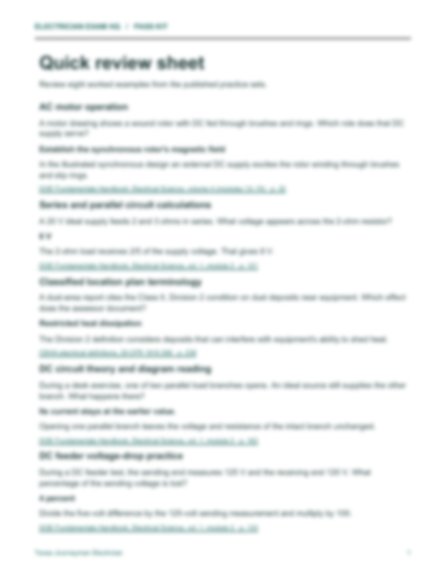
Quick review sheet
Review eight worked examples from the published practice sets.
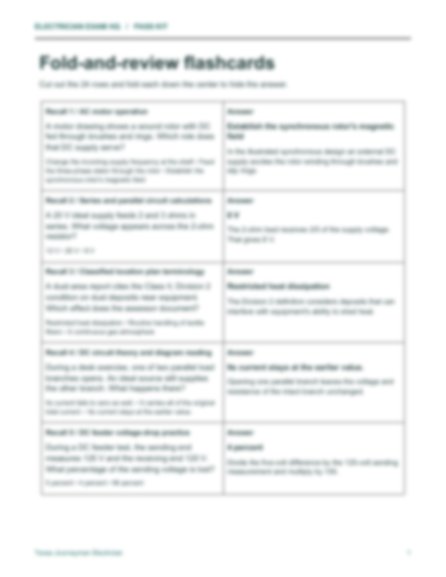
Fold-and-review flashcards
Cut out the 24 rows and fold each down the center to hide the answer.
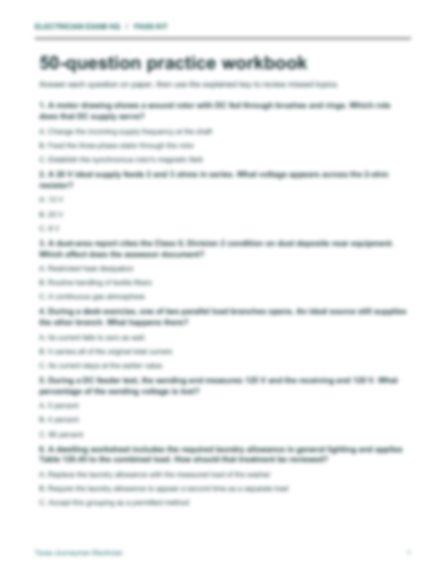
50-question practice workbook
Answer each question on paper, then use the explained key to review missed topics.
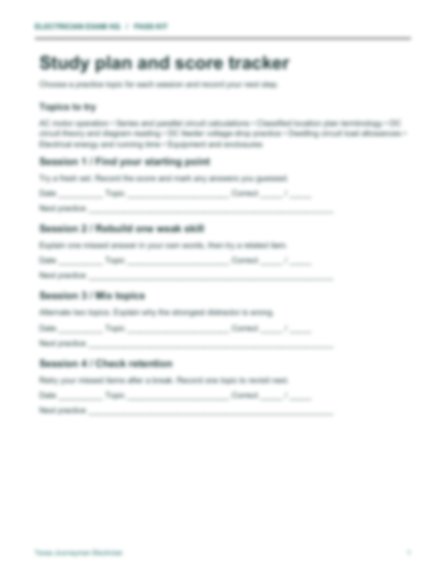
Study plan and score tracker
Choose a practice topic for each session and record your next step.
Exam day checklist
Review the format and fill in your appointment details before you go.
Electrical energy calculation workbook
Calculate energy use, recover a missing runtime, and compare two load schedules.
An ideal single-phase transformer has 480 primary turns and 120 secondary turns. With 240 V applied to the primary, what secondary voltage should you expect?
The secondary has one-quarter as many turns, so its voltage is 240 × (120 ÷ 480) = 60 V. Check the direction before calculating. Fewer secondary turns mean a lower secondary voltage. A result of 960 V signals that the turns ratio was inverted.
Further reading: DOE Fundamentals Handbook: Electrical Science, vol. 4, modules 12–13 (AC Motors and Transformers)
348 questions in the complete bank. The public preview includes 25 questions across the study topics.
Transformer ratio, power and loss practice
Texas journeyman electrician calculations practice
Read and apply federal electrical terms related to circuit paths and supply.
8 questionsRead and apply federal electrical terms related to equipment and enclosures.
8 questionsRead and apply federal electrical terms related to protective terms and current.
8 questionsWork from a steady rate, a total and elapsed time. Check the units in each answer.
18 questionsCompare current paths, voltage drops and equivalent resistance in ideal DC circuit sketches.
12 questionsFind current, equivalent resistance and individual voltage drops in ideal DC diagrams.
18 questionsFollow energy conversion, storage and mounting decisions on original PV drawings.
9 questionsRead source and load winding diagrams, polarity marks, metering symbols and power-loss reports.
10 questionsCalculate winding voltage, current, impedance, losses, efficiency and three-phase winding voltage from the supplied data.
10 questionsInterpret induction torque curves, rotor slip, split-phase starting circuits and synchronous motor fields.
12 questionsReview drawings against federal workplace wiring rules for boxes, raceways, cords and temporary wiring.
9 questionsInterpret meter loading, real power, protective zones and motor control diagrams from stated circuit conditions.
24 questionsRead workplace plan legends for grounding, bonding, isolation and voltage.
10 questionsInterpret workplace area classifications for gases, vapors, dust and fibers under OSHA definitions.
12 questionsCalculate field speed, pole count, supply frequency and slip from motor test records.
8 questionsCheck outlet schedules, markings and device ratings under the federal workplace wiring rule.
8 questionsCalculate conductor resistance, loss and receiving voltage in original resistive DC feeder models. Project limits are given with each problem.
8 questionsApply NEC 2026 section 120.52 to original dwelling worksheets.
5 questionsCheck appliance eligibility and feeder grouping under NEC 2026 section 120.53.
5 questionsCheck nameplate minimums, phase grouping and demand factors under NEC 2026 section 120.54.
5 questionsCalculate feeder allowances, qualifying appliance loads and dryer demand from original schedules using NEC 120.52–54.
12 questionsCalculate DC array output, AC clipping, tracker coverage and losses from original PV system schedules using the NREL PVWatts V5 model.
9 questionsRead pool layout dimensions, elevations and closed or partial perimeter spacing using the 2026 NEC correction for 680.26(B)(2).
8 questionsRead pickup stages, sealed coil demand and regulation requirements using original schedules and the Hammond Power Solutions Spartan control transformer worksheet.
9 questionsCalculate geometric occupancy using cable outside area and raceway inside area. Where an example imposes an occupancy cap, the problem states its project limit.
9 questionsInterpret original equipment schedules, plan details and inspection records under the cited federal workplace electrical requirements.
12 questionsInterpret original equipment schedules, plan details and inspection records under the cited federal workplace electrical requirements.
12 questionsCorrected §240.86(C) requires the particular connection and more than 1 percent of the downstream breaker interrupting capacity.
5 questionsCorrected §720.22(C)(1) identifies permitted methods for other spaces used for environmental air.
5 questionsUse the measurements and equipment data in each original problem to check a design calculation.
3 questionsUse the measurements and equipment data in each original problem to check a design calculation.
2 questionsUse the measurements and equipment data in each original problem to check a design calculation.
5 questionsUse the measurements and equipment data in each original problem to check a design calculation.
2 questionsApply national 2026 changes identified in the Board of Electricity’s public code review to original design scenarios.
7 questionsApply national 2026 changes identified in the Board of Electricity’s public code review to original design scenarios.
3 questionsApply national 2026 changes identified in the Board of Electricity’s public code review to original design scenarios.
6 questionsApply national 2026 changes identified in the Board of Electricity’s public code review to original design scenarios.
7 questionsApply national 2026 changes identified in the Board of Electricity’s public code review to original design scenarios.
9 questionsApply national 2026 changes identified in the Board of Electricity’s public code review to original design scenarios.
10 questionsApply national 2026 changes identified in the Board of Electricity’s public code review to original design scenarios.
6 questionsTexas tests code knowledge and calculations separately. The PSI bulletin sets a 70% passing mark for each portion. Time left in one portion does not carry over.
PSI lists 59 items in 130 minutes, including three unscored items. Practice finding a rule in the edition allowed on your exam date. TDLR currently lists the 2026 NEC.
PSI lists 26 items in 110 minutes, including two unscored items. In the warm-up here, write the requested unit beside the unknown before choosing an operation.
TDLR says candidates bring their own NEC book. Check its binding and marking rules before test day. PSI lists $78 for the two portions and $78 for a retake.